… At this point my mind was only picking up on certain words, like Starvation and Strangling. I asked him, “what do I do? Do I have to put her to sleep?” Luckily, he said “NO”…
What is Persistent Right Aortic Arch?
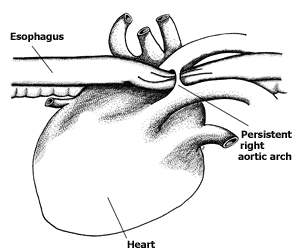
PRAA, or vascular ring anomaly, is a congenital anomaly of the blood vessels of the heart that result in constriction of the esophagus.
In the fetus, there are blood vessels that at first may serve a function, but then naturally deteriorate as the embryo grows. Occasionally, vessels in the chest cavity, called the aortic arches, will fail to disappear. The right aortic arch passes near the esophagus. If this blood vessel persists in the newborn, the esophagus is trapped between it and the heart.
This inhibits the growth and function of the esophagus, thus restricting food passage to the stomach.
In 95% of the cases of a vascular ring anomaly, a constricting band prevents solid foods from passing to the stomach which prevents the puppy from thriving well. In the remaining 5% of cases, a bizarre anomaly of the vessels is present (double aortic arch and aberrant subclavian artery), which may be difficult to correct and may not have a good prognosis.
Signs & Symptoms
Signs of this condition usually become apparent shortly after weaning, when a puppy begins eating semi-solid or solid food. While milk will slide down nicely, bulky foods will “jam up” in the esophagus, leading to a stretched structure and the inability to get food down, hence the symptom known as regurgitation.
taking a thorough medical history to determine if the pup is regurgitating or vomiting is very important. – Dr. Michael Huddleston, DVM, Westheimer Animal Clinic, Bellaire, TX
Regurgitation involves the puppy producing undigested food and mucus through the mouth with no effort; the pup tilts its head down and the food and mucus simply roll out. By contrast, vomiting is an active process, meaning there are abdominal contractions (heaving) and a retching noise when food and mucus are expelled out the mouth.
Regurgitation is synonymous with PRAA and megaesophagus, whereas dozens of disorders may cause a pup to vomit.
Stunted growth (due to an inability to take in nutrients) and breathing problems (often the result of aspiration pneumonia secondary to regurgitation) are other common symptoms.
It is important to note that the vast majority of dogs with vascular ring anomalies do not have true megaesophagus. The esophagus is merely dilated because of the obstruction caused by the vascular ring. -Dr. David Holt, BVSc, Diplomate ACVS, Professor of Surgery, University of Pennsylvania
Treatment
Surgery to correct PRAA
Surgical removal of the stricture (narrowing) caused by the persistent right aortic arch is the preferred treatment. It is important to perform surgery early in the disease, before permanent growth damage has occurred. Generally, puppies between the ages of 2-6 months, that are not severely emaciated or have severe aspiration pneumonia, are considered good candidates for surgery. Under the age of two months, surgery is considered risky due to anesthesia and surgery complications.
Although it is recommended the sooner the vascular ring anomaly is corrected the better, there have been cases of adult dogs that have undergone surgery with success.
Opting out of surgery
In some cases, surgery is not possible. These pups need to follow feeding instructions for Megaesophagus. They need to be fed in an upright position and kept upright for an appropriate amount of time after meals. As long as the stricture or narrowing allows for nutrients to pass into the stomach, these dogs can continue to thrive. Usually consistency of the food is “soupy” or a liquid gruel in order for it to pass by the stricture.
Restricted diet, consisting of liquefied foods, will need to be followed closely to limit the damage to the esophagus due to constant regurgitation.
For those whom surgery is not a candidate, another option is a gastric feeding tube. This allows for nutrition to go directly to the stomach, bypassing the esophagus. Although the idea of a feeding tube seems extreme, many dogs live long happy lives with feeding tubes in place.
For more information please click on the tab marked “Feeding Tubes”.
There are two types of surgeries you can elect to have for your puppy.
- Classic Thoracotomy (opening the chest)
- Minimally Invasive Surgery (MIS) – Thoracoscopy. MIS allows diagnostic and/or therapeutic surgical procedures to be performed using very small incisions through which a camera and instruments are placed inside body cavities.
Advantages of MIS include:
-
- decreased pain,
- better visualization (due to the magnified high-resolution images produced)
- reduced risk of wound complications and infections
- shorter hospitalization times
You always have to be prepared to convert to an open procedure (thoracotomy) when doing MIS in cases of unexpected hemorrhage or poor exposure. – Dr. James A Flanders, DVM Diplomate, ACVS, Associate Professor, Cornell University
Cost of surgery is between 2 and 6 thousand dollars, depending on the facility and geographic location. MIS surgery may run higher but may require minimal post-operative hospital care.
Diagnosis
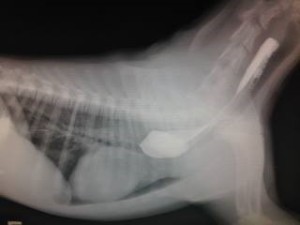
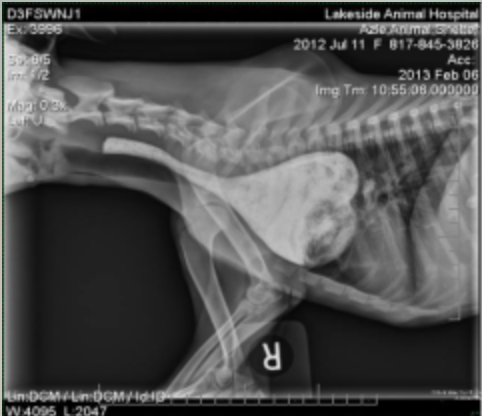
- Thoracic radiograph (X-Ray) made after a barium (a gastrointestinal contrast material) swallow. The esophagus in front of the heart will appear dilated. In some cases the esophagus behind the heart will also be dilated. This is a warning sign that the puppy could have poor function of the esophagus even if surgery is performed. There is a slight chance the puppy could aspirate the barium and special precautions should be taken. The barium should be administered in an upright position and minimize the time the puppy is laying on his side.Sit the puppy back up quickly to allow safe passage of the barium to the stomach.
- Thoracic radiographs (x-rays) are also used to determine if the puppy has aspiration pneumonia (AP)
- Blood tests, including a complete blood count (CBC), chemistry profile and urinalysis are recommended to make sure that the puppy has healthy internal organs prior to surgery and may show signs of low blood sugar or a high white blood cell count if infection is present.
- An ultrasound may also be recommended to rule out other congenital heart defects that may require attention.
- The esophagus may also be evaluated with a flexible endoscope (under anesthesia).
- A contrast CT may also be ordered.
Thoracotomy Surgery
Prior to surgery, it is important to provide as much nutrition as possible to the puppy. This may include feeding a high calorie gruel. During and after feeding a meal, the puppy must sit upright so to make sure that the food will pass into the stomach by means of gravity.
If pneumonia is present it should be treated with antibiotics, nebulization, and coupaging the chest to bring up phlegm.
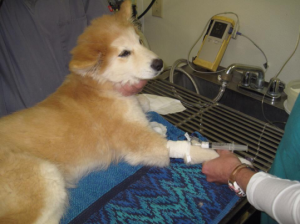
On the day of surgery, an intravenous catheter will be placed to provide intravenous fluid therapy. Young puppies are also very susceptible to developing low blood sugar, therefore a sugar solution is typically incorporated in the intravenous fluids.
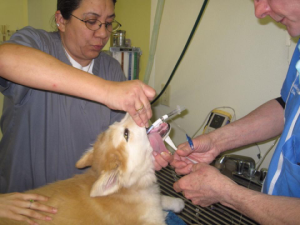
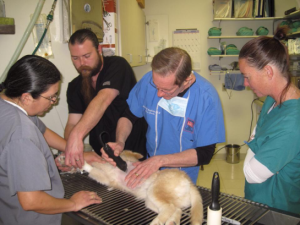
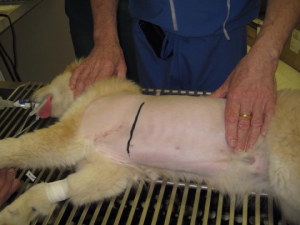
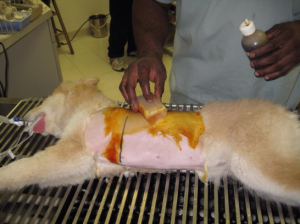
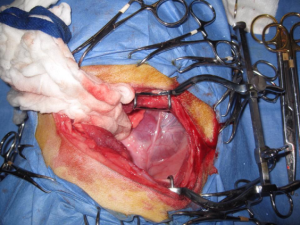
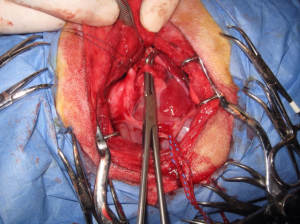
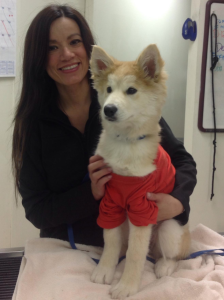
The photos below show Chloe’s surgery:
An incision is made on the left side of the chest and the fourth and fifth ribs are spread to expose the band (ligamentum arteriosum), constricting the esophagus. The band is readily identified by running a finger or the tip of a surgical instrument along the esophagus. The phrenic, vagus and recurrent laryngeal nerves, located near the constricting band are identified and protected during the procedure.
The constricting band is isolated using a surgical instrument, tied twice with suture and cut. The constricting band must be tied off, as the ligamentum arteriosum frequently still is a patent vessel in very young animals. After the constricting band is cut, fibrous tissue that may be constricting the esophagus is dissected off the esophagus. A tube is placed down the mouth and through the area of the esophagus to make sure that there are no additional constrictions.
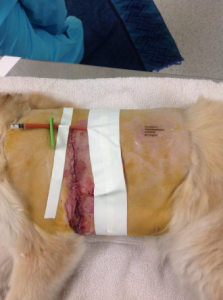
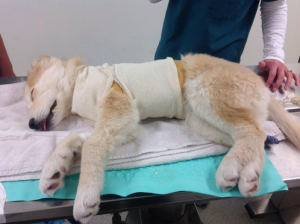
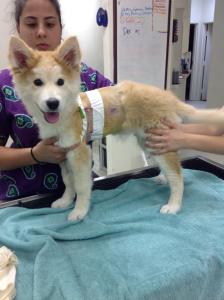
After surgery, medication is given to your puppy to ensure a pain-free recovery. Intravenous fluids are administered at least over night or longer if indicated. Once the puppy is eating and drinking well, intravenous fluids may be discontinued.
Your puppy may have a chest tube after surgery, which is used to remove fluid and air from the chest cavity. Typically, the tube can be removed after 12 to 24 hours. Some surgeons prefer to administer pain relieving medication (local anesthetic) through the tube to numb the incision.
Upright feedings may be required for an additional month after surgery. If the puppy is no longer regurgitating, the upright feedings can be discontinued. Once the puppy can swallow well and there is no regurgitation, solid foods can be gradually introduced.
Exercise must be restricted for 3 weeks after surgery so that the surgical site can heal properly.
Just 48 hours after PRAA surgery, Chloe is ready to go home!
Prognosis
Prognosis is very good! Overall, about 90% of dogs having surgery to correct this condition will have resolution of the regurgitation and they thrive. The remaining dogs may do poorly or may be improved from the preoperative condition.
View the complete list of Accredited Colleges of Veterinary Medicine throughout the world
Special thanks to Dr. Mike Huddleston for pictures of Chloe. Dr. Huddleston has performed over 24 PRAA successful surgeries. Special thanks to Dr. Holt from the University of Pennsylvania and Dr. Flanders from the University of Cornell for their help in writing this article. Both these University Veterinarian Schools perform both classic thoracotomy and thoracoscopy (MIS) surgeries to correct PRAA.